

Commentary
Kadri Liik
{
  "authors": [
    "Kadri Liik"
  ],
  "type": "commentary",
  "blog": "Strategic Europe",
  "centerAffiliationAll": "",
  "centers": [
    "Carnegie Endowment for International Peace",
    "Carnegie Europe"
  ],
  "englishNewsletterAll": "",
  "nonEnglishNewsletterAll": "",
  "primaryCenter": "Carnegie Europe",
  "programAffiliation": "",
  "regions": [
    "Europe",
    "Ukraine",
    "Russia",
    "United States"
  ],
  "topics": [
    "EU",
    "Foreign Policy"
  ]
}
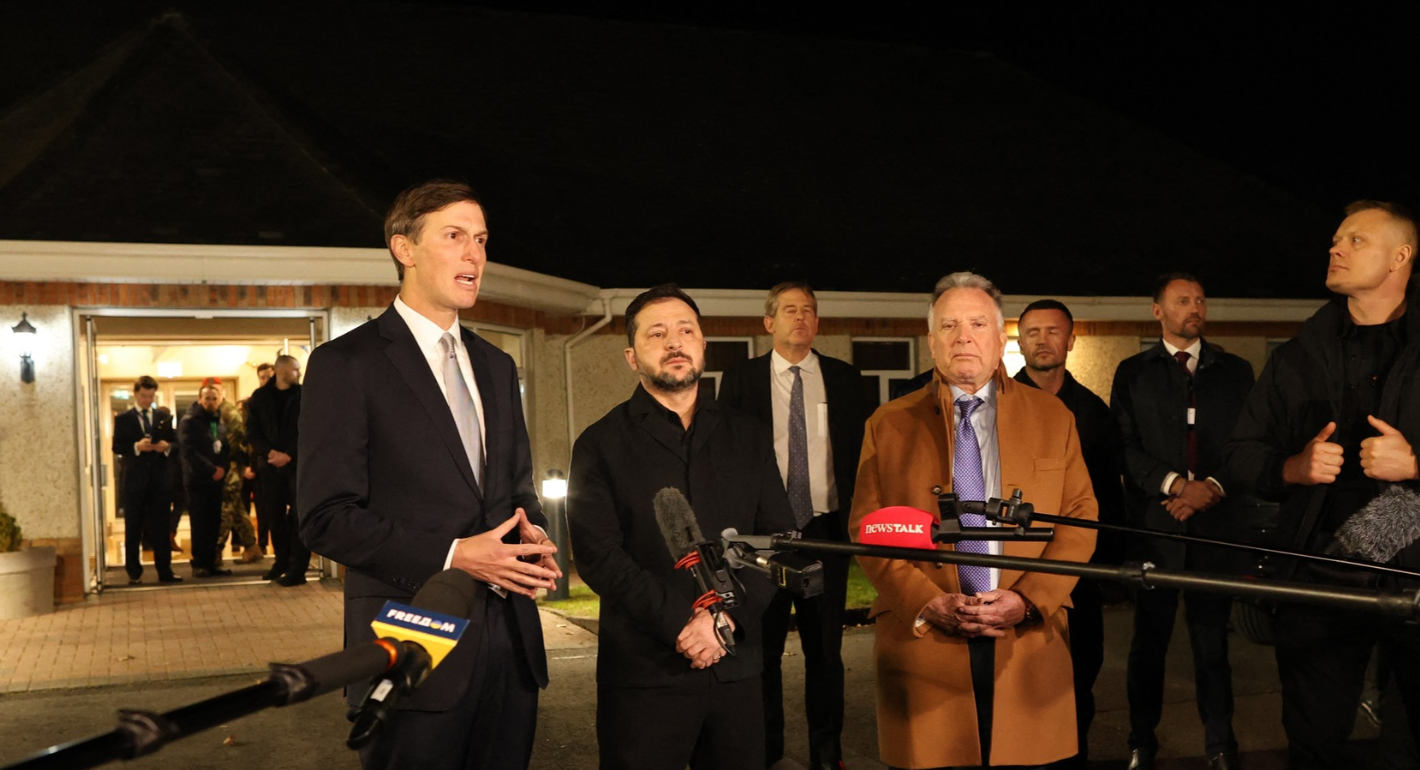
Source: Getty
Russia’s maximalist demands are preventing any serious attempt at ending the war in Ukraine. To make peace a realistic prospect, Putin must recognize that diplomacy is a two-way street.
Outwardly, these have been successful weeks for Russian diplomacy. At a trilateral meeting with U.S. and Ukrainian negotiators in Abu Dhabi, Moscow revived its demands to change Europe’s security arrangements. The demand failed to meet strong pushback from Washington, and the Europeans—despite being opposed to such demands—scrambled to form a negotiating delegation.
Meanwhile, a summit between Russian President Vladimir Putin and his U.S. and Chinese counterparts, Donald Trump and Xi Jinping, is a dream come true. It might not deliver much in the end, but Putin must love the format. The idea that the world should be ruled by a few strongmen who are each responsible for their own region has always been close to his heart. It is no accident that in his speeches, Putin has repeatedly cited the 1945 Yalta Conference, where the Soviet Union, United States, and United Kingdom carved Europe up in the wake of the Second World War, as a model for settling international affairs—and the system that resulted as a positive example that granted long-term stability to the continent.
What these weeks have not brought closer, though, is an end to the war in Ukraine. It also remains unclear whether sticking to maximalist demands will serve Russia’s interests in the end, or whether Moscow will overplay its hand and achieve an sub-optimal outcome, also from its perspective.
Ever since Donald Trump returned to the White House, Russia’s negotiating tactic has relied on three pillars. As wittily paraphrased by a Russian expert, Moscow has sought to keep the United States in, Europe out, and Ukraine down. In other words, it has sought to avoid a fallout with Washington and tried to ensure that Europe cannot get a proper say, all while maintaining its ambitions in the war against Ukraine.
This has not changed. Although Putin has had a few phone calls with European leaders, Moscow’s reluctance to engage remains evident. As said by Yuri Ushakov, President Putin’s foreign policy adviser, “a great deal would have to be done” before Europe could join the talks with the United States, Russia, and Ukraine. In his words, Russia wanted to receive “a clear signal from the Europeans about what they want and what constructive, substantive contribution they can make to a successful settlement in Ukraine.”
It is almost certain that the Europeans cannot come up with anything that Moscow would call sufficiently constructive. They will not accept that borders can be changed by force, that Ukraine must become a dismembered, demilitarized, and vulnerable country, or that Russia should have a veto over how NATO members organize their security—all of these are part of Moscow’s vision for a new European order.
Furthermore, despite its loud demands, it is not clear how serious Russia actually is about discussing that order. Growing dissatisfaction with it has indeed been a persistent theme in the country’s foreign policy agenda. Yet, when some in the West finally reciprocated by showing readiness to discuss these matters, Moscow did not go along. It never engaged with French President Emmanuel Macron’s 2019 suggestion to discuss European security with Russia. It also failed to engage with then-U.S. president Joe Biden in 2021. While Biden rejected the most far-reaching of Russia’s demands, such as a retreat from NATO’s nuclear sharing arrangements, he was willing to talk about principles of security in Europe and discuss quite far-reaching arms control and confidence-building measures. Ukraine remaining outside the alliance was also within Moscow’s reach during the critical weeks in early 2022. It remains hard to understand why it rejected all that and started a war it cannot win.
Likewise, a bitter deal to end the war might be available now, at least in theory, but the maximalist demands that Moscow has reiterated put it out of reach. In the fifth year of Russia’s war against Ukraine, there is simply no way that that the European NATO members would agree to weaken their own defense arrangements. Moscow must know that.
In 2019, Ukrainian President Volodymyr Zelensky won the Ukrainian elections on a promise to end the standoff in Donbas. He meant it and was ready to go a long way to achieve it. But Moscow’s inflexible interpretation of the 2014–2015 Minsk agreements, one which aimed to strip Ukraine of any meaningful sovereignty, made a breakthrough impossible. Hoping that swift military action could achieve more than plodding negotiations, Moscow launched the war—to Ukraine’s peril, but also to its own.
It could be that Russia is making a similar mistake now, preferring to keep fighting in the hope that it will find itself in a better position later, for instance in spring 2027. By that time, Ukraine will have suffered a hard winter and France might have elected far-right leader Marine Le Pen as its new president. It could be that this calculation is correct, but it could also be that it misses the optimal moment to end the war. For Putin, perfect is all too often the enemy of good.
Notwithstanding this, it is probably good that Europe has now accepted the possibility that it will eventually need to talk to Russia. The idea that Moscow could be ignored until it changes its thinking and behavior was never realistic. True, the Europeans are still struggling to agree on who should represent them. It is hard to see how the current set up with the so-called E5 countries—consisting of France, Germany, Italy, Poland, and the UK—plus the European Commission and European Council would work in real-life negotiations. But it is not a bad thing for this group to start official consultations and preparations. Europe needs to think about its goals and strategy, its leverage, its red lines, compromises it could potentially make, and its carrots and sticks.
All this work will be needed. But before diplomacy can have its day, the likelihood is that cannons will keep doing the talking.
Subscribe to Strategic Europe, delivered every Tuesday and Thursday!
Visiting Scholar, Carnegie Europe
Kadri Liik is a visiting scholar at Carnegie Europe. Her expertise includes Russian domestic and foreign policy and the EU's position toward Russia.
Recent Work
Kadri Liik
Carnegie does not take institutional positions on public policy issues; the views represented herein are those of the author(s) and do not necessarily reflect the views of Carnegie, its staff, or its trustees.

Too many national interests, too many EU institutions, and too little political will are preventing Europe from acting in its own best interests.
Judy Dempsey
A sizeable funding shortfall looks increasingly likely to hit Ukraine in 2027. Can the Europeans, with their strained budgets and economies, come up with the cash without seizing frozen Russian assets?

Rym Momtaz, ed.
A blue wave has swept over the U.S. midterms, with Democrats regaining control of both houses of Congress. But Europeans hoping for a return to business as usual should think again.
Rym Momtaz
In Germany, competing perceptions of Russia are highlighting a tension between public opinion and government policy. In the country’s east, where division is widespread, populist parties are taking advantage.

Gwendolyn Sasse
The European Commission is preparing the EU for its next enlargement. But member states need to make it a project that European citizens can understand, shape, and support.

Iliriana Gjoni